

Mater Dolorosa, or Sorrowful Mother, names a tradition that painters have approached through portraits, paired panels, and larger devotional ensembles. A folded hand, a narrow shaft of light, or the direction of Mary’s eyes can do as much work as an entire Passion scene. This guide compares ten paintings from Dürer through the nineteenth century, including two treatments of the same subject by Titian.
Simeon’s prophecy in Luke 2:34–35 and Mary’s presence at the Cross in John 19:25–27 give the tradition two biblical points of reference. Use the notes below to compare how each painting handles the face, the hands, and the space around Mary.
1. The Good Shepherd — Bartolomé Esteban Murillo

Murillo makes the shepherd a child. Look at the closeness of Jesus and the sheep, then compare the scale of their relationship with Cole’s expansive landscape. Murillo’s approach makes care visible in an intimate encounter. Artwork reference
2. The Good Shepherd — Henry Ossawa Tanner

Tanner’s painting offers an early twentieth-century reading of a long-established theme. Study where the figure separates from the setting and where the edges soften. The treatment of light and space changes the emotional pace after Murillo.
3. The Good Shepherd — Luca Giordano

Giordano’s Baroque treatment is an opportunity to examine the physical gesture. Follow the arrangement of face, hands and animal. Compare how quickly that gesture reads with the time needed to take in Cole’s landscape.
4. The Good Shepherd — Thomas Cole

Cole builds a landscape around sacred imagery. Crystal Bridges links the painting to Psalm 23. Looking at where the figures sit within the larger setting makes clear how much of the picture’s meaning comes from the terrain. Artwork reference
5. The Parable of the Lost Sheep — John Atkinson Grimshaw

Grimshaw gives the lost sheep a setting that is worth studying before the figures. Compare the depth and atmosphere of the landscape with the enclosed feeling of a devotional portrait. In the parable, the search itself carries part of the meaning.
6. Behold the Lamb of God — Dieric Bouts

Here the title comes from the words of John the Baptist. The Alte Pinakothek reads the scene in relation to John’s preaching by the Jordan. Compare how the gesture of pointing works as a sign of recognition. Artwork reference
7. Ecce Agnus Dei — Juan de Flandes

The title translates as “Behold the Lamb of God.” The story asks viewers to follow a witness’s attention toward Jesus. That relationship plays a different role from the direct contact between shepherd and sheep in the works above. Museum reference on the subject
8. Adoration of the Mystic Lamb — Hubert and Jan van Eyck

The Ghent Altarpiece places the Lamb at the center of an act of worship. Look at how the surrounding groups direct their attention inward. The broad assembly makes a useful comparison with Zurbarán’s isolated animal.
9. Agnus Dei — Francisco de Zurbarán

Zurbarán returned to the image of a lamb in several paintings. In this treatment the close view encourages careful looking at the wool and the still figure. The simplicity of the arrangement makes the sacrificial reading of the subject prominent.
10. Agnus Dei — Josefa de Óbidos
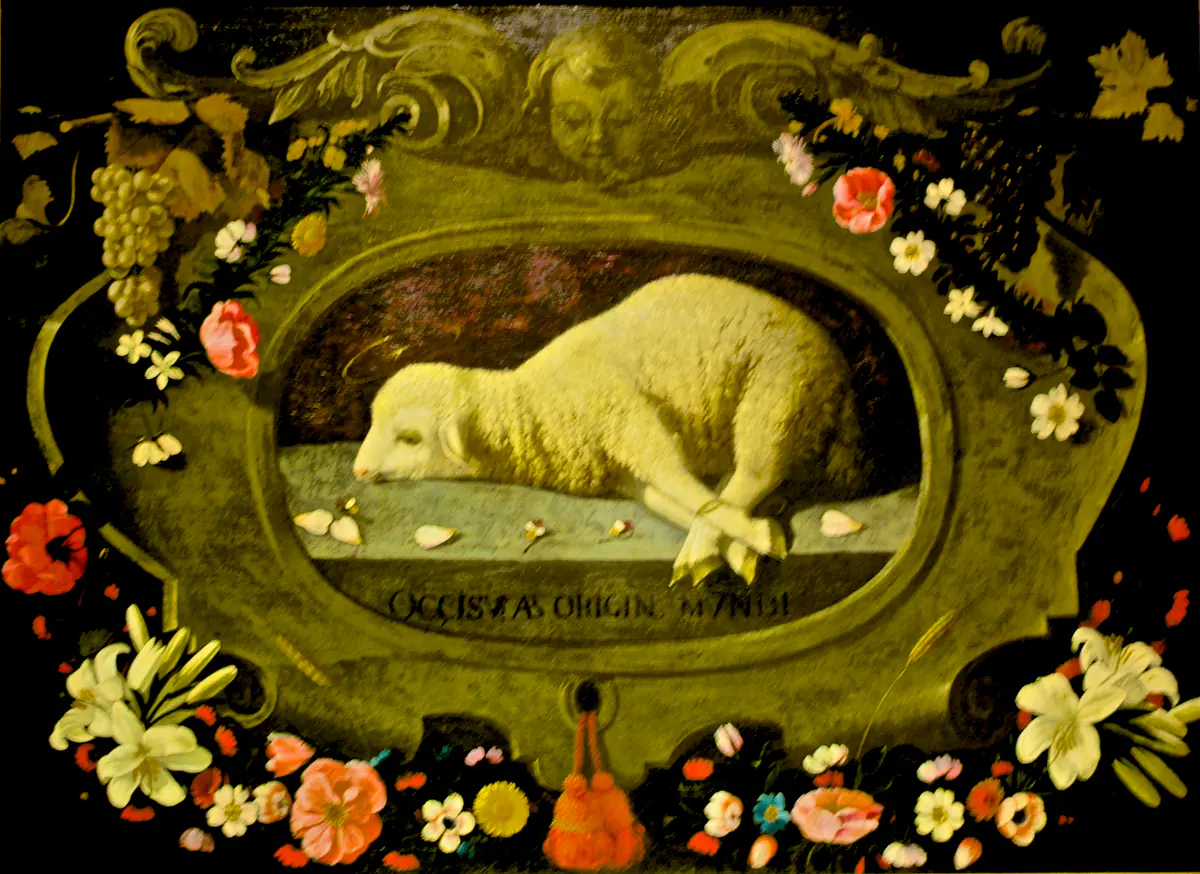
The lamb appears as an emblem of Christ, a subject also explored by Zurbarán. Compare what each painter does with the space immediately around the animal. The different treatments show how much atmosphere can change a composition built around one figure.
How to compare the gestures
Start with Titian’s two versions. The clasped hands give the gaze a compact route upward, while the separated hands bring attention to the space in front of Mary. Then turn to the paired Bouts composition and see how much of the picture’s meaning comes from the relationship between two panels.
How do the Seven Sorrows fit the tradition?
The Seven Sorrows trace episodes from Simeon’s prophecy to Christ’s burial. Dürer’s ensemble originally surrounded Mary with narrative panels. A single portrait can condense the devotion into one expression, often leaving the scene of the Passion to the viewer’s memory.